Gangnam Eye & Eye Revision Surgery Specialist · Personalized 1:1 Care


Medical Guide
Jawline Lift vs Non-Surgical Jaw Contouring Compared
Surgical Jawline Lift repositions sagging tissue; non-surgical jaw contouring uses injectables and energy devices. Compare results, recovery, and safety.
Schedule a ConsultationJawline Lift vs Non-Surgical Jaw Contouring: Comparing Results and Recovery
Medically reviewed by Dr. Karam Kim, Korean Board-Certified Plastic Surgeon
A surgical Jawline Lift and non-surgical jaw contouring are often discussed together, but they address the lower face in fundamentally different ways. A Jawline Lift is a surgical procedure that repositions descended soft tissue to restore definition, while non-surgical contouring uses injectables or energy-based devices to slim, tighten, or refine the area without surgery. Because the underlying concern differs from person to person, whether either option, both, or neither is appropriate is an individualized decision. This article compares how the approaches work, what results and recovery each typically involves, and how the treatments are regulated, so you can ask better questions at a consultation.

Two Different Problems, Two Different Approaches
Before comparing techniques, it helps to be clear about what "jawline concern" actually means, because the word covers several distinct situations that call for different solutions.
Some people are bothered by soft-tissue descent: with age, the fat, muscle, and skin of the lower face gradually sag, jowls form along the jawline, and the crisp transition between the jaw and the neck softens. This is a structural problem, and it is the concern a surgical Jawline Lift is designed to address.
Other people have a jaw that looks wide or square because of a bulky masseter muscle or the underlying bone, rather than because of sagging. Others feel their jawline is poorly defined simply because the chin or jaw angle lacks projection, or because skin has lost some firmness. These are different issues, and some of them are the target of non-surgical options such as muscle-relaxing injections, fillers, or energy-based skin tightening.
Understanding which category your concern falls into is the single most useful step, because a treatment aimed at the wrong problem will not produce the result you want. A whole-face assessment by a qualified medical provider is generally more reliable than trying to self-diagnose the cause.
The Surgical Jawline Lift
At Afternoon Plastic Surgery Clinic, a Jawline Lift is documented as a surgical procedure designed to restore definition to the jawline by repositioning descended lower-facial tissues. Rather than treating the jawline in isolation, the documented approach evaluates the jaw, neck, chin, jaw angle, and surrounding soft tissue as a structural unit, and every surgical plan is individually designed around the patient's anatomy and goals.
Because it works at the structural level, a surgical lift targets the cause of lower-facial sagging directly: it repositions and secures tissue that has descended. The clinic documents that suitable candidates are typically people with progressive loss of jawline definition, jowl formation, softening of the jaw-to-neck transition, or general lower-facial tissue descent. It also documents that a Jawline Lift is generally not the right approach when the concern is primarily bone structure or jaw width rather than soft-tissue sagging, which is an important distinction when deciding between surgical and non-surgical options.
As a surgical procedure, a Jawline Lift involves incisions, a healing period, and the realistic risks that accompany any operation, such as swelling, bruising, temporary numbness, and scarring. Specific details, including anesthesia, technique, and the recovery timeline, depend on the individual plan and are confirmed by the clinic during consultation. Results vary between individuals, surgery does not stop the natural aging process, and no specific outcome can be guaranteed. What surgery can offer, compared with non-surgical contouring, is a more direct correction of structural descent and, generally, a longer-lasting change, at the trade-off of a true surgical recovery.
Non-Surgical Jaw Contouring: The Main Options
"Non-surgical jaw contouring" is an umbrella term for several very different treatments. They avoid incisions and surgical recovery, but they also work more superficially than surgery, their effects are usually temporary, and their regulatory status in the United States varies by product and by the specific area being treated. The distinctions below matter.
Masseter (jaw-slimming) botulinum toxin — off-label in the US
One of the most requested non-surgical treatments for a "wide" jaw is injection of botulinum toxin (for example, Botox, onabotulinumtoxinA) into the masseter, the muscle that closes the jaw. When the masseter is enlarged, relaxing it can, over time, reduce its bulk and soften a square lower-face appearance. It is worth being precise about what this does and does not treat: it addresses muscle bulk, not sagging skin or jowls, so it is not a substitute for a lift.
It is also important to understand the regulatory status. In the United States, Botox Cosmetic (onabotulinumtoxinA) is FDA-approved for specific cosmetic indications only: moderate to severe glabellar (frown) lines, lateral canthal lines (crow's feet), and forehead lines in adults. Masseter injection for jaw slimming is not among these approved indications, so in the US it is considered an off-label use. Off-label use is legal and common in medicine, but it is a meaningful distinction to understand and to discuss with your provider. The effect is temporary, typically developing over about two weeks and lasting on the order of a few months before repeat treatment is needed, and side effects can include bruising, temporary chewing changes, or asymmetry.
Dermal fillers for the jaw and chin — FDA-approved but area-specific
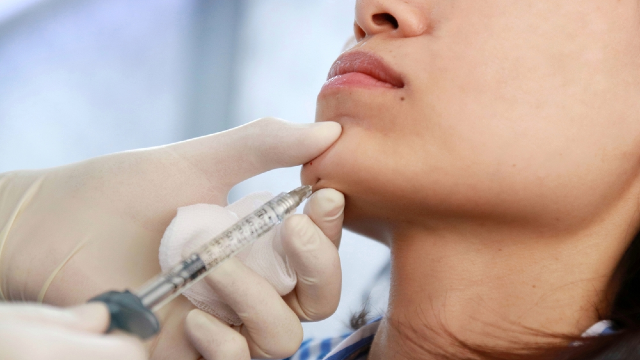
Hyaluronic acid (HA) dermal fillers can be used to add projection or definition to the chin and jaw angle, which some people describe as "contouring." Fillers are regulated by the FDA as medical devices, and their approvals are area-specific and product-specific. The FDA lists approved uses such as correcting facial wrinkles and folds and augmenting the lips, cheeks, chin, and back of the hand. Because approvals are tied to specific areas and products, a given filler placed along the jawline or jaw angle may fall outside that product's approved indication and be considered off-label — a point worth confirming with your provider. In addition, fillers available in the Korean market may be approved by Korea's Ministry of Food and Drug Safety (MFDS) rather than the US FDA, so it is reasonable to ask which product is being used and how it is regulated. Filler results are temporary, and while serious complications are rare, injecting into a blood vessel can cause vascular problems, so placement requires detailed anatomical knowledge.
Energy-based devices: RF, ultrasound, and Korean-market systems
A large share of "non-surgical jaw contouring" is marketed around energy-based devices that use radiofrequency (RF) or focused ultrasound to heat tissue and stimulate collagen, with the goal of modest skin tightening along the jawline. The key point for a US patient is that regulatory status depends on the specific device and its cleared indication. Some energy-based devices have US FDA clearance for particular uses, while many systems used in the Korean aesthetic market — including devices you may see advertised for jaw or lower-face "lifting" — are approved by the Korean MFDS and are not US-FDA-approved. Regulatory approval does not transfer between countries, so it is sensible to ask, for any device, exactly what it is and how it is regulated. Energy-based tightening generally produces subtle changes rather than the structural correction of a surgical lift, results vary, and maintenance sessions are often needed.
Fat-focused options
Where a fuller lower face relates to a small pocket of submental (under-chin) fat, some treatments target fat rather than muscle or skin. In the US, the only FDA-approved injectable specifically for submental fat is deoxycholic acid (Kybella). This is distinct from jaw contouring for sagging or muscle bulk, and it illustrates again why matching the treatment to the actual cause matters.
Comparing Results and Recovery
The clearest way to weigh the two categories is by matching each to the underlying concern, then considering longevity and recovery.
- What each addresses. A surgical Jawline Lift repositions descended tissue, so it targets sagging and jowls at the structural level. Non-surgical options each address a narrower issue: muscle-relaxing injections for a bulky masseter, fillers for projection or definition, and energy devices for modest skin tightening. Non-surgical treatments generally do not lift significantly descended tissue.
- Longevity. Surgical correction is typically longer-lasting, though no procedure stops aging and results are not permanent. Non-surgical results are usually temporary and require repeat treatment to maintain.
- Recovery and downtime. Surgery involves a genuine healing period with swelling, bruising, and activity restrictions. Most non-surgical treatments involve little or no downtime, though temporary redness, swelling, or bruising can occur.
- Risk profile. Every option carries risks. Surgery has the risks inherent to an operation and anesthesia; injectables carry risks such as bruising and, rarely, vascular complications; energy devices can cause temporary redness or, uncommonly, burns or nerve irritation.
There is no universal "better" option, and any claim that one approach is always superior oversimplifies the decision. The right choice depends on the cause of your concern, your anatomy, your tolerance for downtime, and your goals for how long a result should last.
Which Is Right for You? An Individualized Decision

Because the treatments target different problems, the choice should follow a diagnosis rather than precede it. Someone whose main concern is sagging jowls and a blurred jaw-to-neck line has a structural issue that non-surgical contouring is unlikely to resolve well; someone whose concern is a bulky masseter or a slightly under-projected chin may be better served by non-surgical options. Many people fall somewhere in between, and in some cases surgical and non-surgical approaches are used at different stages or for different features.
A thorough consultation is where this is sorted out. A qualified medical provider can assess the lower face as a whole, explain which cause is driving your concern, and set out realistic expectations and risks for each option. If you would like to discuss the documented options, you can arrange a personal consultation with the clinic.
What Afternoon Plastic Surgery Clinic Documents
Afternoon Plastic Surgery Clinic, in the Gangnam district of Seoul, documents both surgical Facial Lifting procedures — including a Jawline Lift — and a range of non-surgical "petit" treatments such as botulinum toxin, fillers, and skin boosters. The clinic documents that Dr. Karam Kim, a Korean board-certified plastic surgeon, personally performs every consultation, surgical design, procedure, and follow-up, that surgery is limited to two patients per day for focused care, and that a Jawline Lift is planned individually after evaluating the jaw, neck, chin, and soft tissue together. For international patients, the clinic documents that remote pre-consultation by photograph and remote follow-up are available.
This is presented as documented information about how the practice is organized, not as a claim that any single option is best or safest for a given patient. Whether a surgical lift, a non-surgical treatment, both, or neither is appropriate for you can only be determined through an individualized assessment.
The Bottom Line
- A surgical Jawline Lift repositions descended soft tissue to address sagging and jowls at the structural level; non-surgical jaw contouring uses injectables or energy devices to slim, add projection, or modestly tighten, and generally does not lift significantly descended tissue.
- In the US, masseter (jaw-slimming) botulinum toxin is an off-label use, because Botox Cosmetic is FDA-approved only for glabellar lines, crow's feet, and forehead lines.
- HA fillers are FDA-approved as area-specific devices, and jaw or chin placements may fall outside a product's approved indication (off-label); Korean-market fillers may be MFDS-approved rather than FDA-approved.
- Energy-based (RF/ultrasound) contouring devices vary in regulatory status by device and indication; many Korean-market systems are MFDS-approved and not US-FDA-approved, so ask what each device is and how it is regulated.
- Results vary, non-surgical effects are usually temporary, surgery involves real recovery and risk, and no outcome is guaranteed; the right choice is individualized and best determined at a consultation.
Frequently Asked Questions
Is a Jawline Lift the same as jaw-slimming Botox?
No. A surgical Jawline Lift repositions sagging soft tissue to restore lower-facial definition, whereas masseter (jaw-slimming) botulinum toxin relaxes the chewing muscle to reduce its bulk. They address different concerns — descent versus muscle size — so one is not a substitute for the other. Which, if either, suits you depends on the cause of your concern.
Is masseter Botox FDA-approved in the United States?
No. Botox Cosmetic (onabotulinumtoxinA) is FDA-approved only for moderate to severe glabellar (frown) lines, lateral canthal lines (crow's feet), and forehead lines in adults. Injecting the masseter for jaw slimming falls outside these indications, so in the US it is considered an off-label use. Off-label use is legal and common, but it is worth discussing with your provider.
Are jaw and chin fillers FDA-approved?
Dermal fillers are FDA-approved as medical devices for specific areas and products, such as facial wrinkles and folds and augmentation of the lips, cheeks, and chin. Because approvals are area- and product-specific, a filler placed along the jawline or jaw angle may be outside that product's approved indication and considered off-label. Fillers used in Korea may be MFDS-approved rather than FDA-approved, so it is reasonable to ask which product is used.
Are the energy devices used for jaw contouring FDA-approved?
It depends on the specific device and its cleared indication. Some energy-based (radiofrequency or ultrasound) devices have US FDA clearance for particular uses, but many systems used in the Korean market are approved by the Korean MFDS and are not US-FDA-approved. Regulatory approval does not carry over between countries, so ask exactly what device is being used and how it is regulated.
How long do non-surgical results last compared with surgery?
Non-surgical results are generally temporary. Muscle-relaxing injections typically last on the order of a few months, filler results depend on the product and area and are gradually absorbed, and energy-device effects often require maintenance sessions. Surgical correction is usually longer-lasting, though no procedure halts aging and results are not permanent. Individual results vary in every case.
Which option has less downtime?
Non-surgical treatments generally involve little to no downtime, with possible temporary redness, swelling, or bruising, whereas a surgical Jawline Lift involves a genuine recovery period. Lower downtime, however, comes with more limited and shorter-lived results. The trade-off between recovery time and the extent and longevity of the change is part of an individualized decision.
Can non-surgical treatments replace a surgical Jawline Lift?
Usually not, if the underlying concern is significant soft-tissue sagging, because non-surgical options do not reposition descended tissue the way surgery does. They may be well suited to different concerns, such as a bulky masseter or a slightly under-projected chin, and are sometimes used alongside or before considering surgery. A consultation is the best way to determine what fits your specific anatomy and goals.
This article is for general informational purposes and does not constitute individualized medical advice. Candidacy, technique, and expected outcomes can only be determined through a consultation with a qualified medical provider. It is not a self-diagnosis tool.
More Articles
Continue reading our clinical guides.

Korean Board-Certified Care: Safety in Eye Revision Standards 2026
Eyelid surgery remains South Korea's most requested cosmetic operation, with 5%–8% primary revision rates. This 2026 clinical guide details safety standards, cost ranges, and high-precision micro-dissection at Afternoon Plastic Surgery Clinic.
Learn More

Time Zone & Communication Tips for a Korean Surgeon
How US patients bridge KST and US time zones consulting a Korean surgeon: planning consult windows, async messaging, and keeping a clear written record.
Learn More

Anesthesia Safety in Korean Eye Surgery: Sedation Explained
Understand anesthesia safety for Korean eye surgery: how local anesthesia with sedation differs from general anesthesia, monitoring, and the real risks.
Learn More